Category: Investing
Quick Thoughts on The Signal and the Noise
Learning to think probabilistically is one of the most critical skills one can master. Nate Silver’s The Signal and the Noise: Why So Many Predictions Fail–but Some Don’t
This book pairs well with Against the Gods

Anyways, here are a few key insights from my notes on The Signal and the Noise
1) Data is useless without context.
There are always patterns to find in data, but its critical to understand the theory behind the system you are studying to avoid being fooled by noise. This is true in forecasting the weather, investing, betting on sports, or any other probabilistic endeavor. The ability to understand context is also a critical advantage humans have over computer programs.
“Statistical inferences are much stronger when backed up by theory or at least some deeper thinking about their root causes. “
The importance of understanding context comes to the forefront when you compare human’s success with weather forecasting, vs relative failure with earthquake forecasting.
“Chaos theory is a demon that can be tamed- weather forecasts did so, at least in part. But weather forecasters have a much better theoretical understanding of th earth’s atmosphere than seismologists do of the earth’s crust. They know more or less, how weather works, right down to the molecular level. Seismologists don’t have that advantage. “
The ability to understand context is what separates success from failure in all pursuits dealing with uncertainty. The profile of professional sports gambler Bob Voulgaris, is highly instructive. Voulgaris focuses on NBA basketball. A key insight is that Voulgaris has powerful tools for analyzing data, and he makes good use of the data, but he also has deep understanding of the qualitative subletities of how NBA basketball works. Obvious statistical patterns are quickly incorporated into betting lines, whether they are signal or noise. Voulgaris looks deeper, and finds places where the line misprices true probabilities.
“Finding patterns is easy in any data rich environment; thats what mediocre gamblers do. The key is in determining whether the patterns represent noise or signal. “
2) Beware of overconfidence
“… the amount of confidence someone expresses in a prediction is not good indication of its accuracy, to the contrary, these qualities are often inversely correlated. “
3) Think big, and think small. Mix the macro and the micro.
“Good innovators typically think very big, and they think very small. New ideas are sometimes found in the most granular of details where few others bother to look. And they are sometimes found when you are doing your most abstract and philosophical thinking, considering why the world is the way that it is and whether there might be an alternative to the dominant paradigm.”
This is reminiscent of the “global micro” approach used by several manager’s profiled in Inside the House of Money: Top Hedge Fund Traders on Profiting in the Global Markets
4) Recognize the Value of Bayesian Thinking
The work of Thomas Bayes forms the framework underlying how good gamblers think.
Bayes was an English minister who argued in his theological work that admitting our own imperfections is a necessary step on the way to redemption. His most famous work, however, was “An Essay toward Solving a Problem in the Doctrine of Chances,” which was not published until after his death. One interpretation of the essay concerns a person who emerges into the world( ie Adam, or someone from Plato’s cave), and rises to see the sun for the first time:
“At first the does not know whether this is typical of some sort of freak occurrence. However each day that he survives and the sun rises again, his confidence increases that it is a permanent feature of nature. Gradually, through this purely statistical form of inference, the probability that he assigns to his prediction that the sun will rise again tomorrow approaches(although never exactly reaches) 100 percent.”
In essence, beliefs on probability are updated as new information comes in.
Ironically Bayes philosophical work was extended by the mathematician and astronomer Pierre Simon-Laplace, who was likely an atheist. Although Laplace believed in scientific determinism, he was frustrated with the disconnect between (what he believed to be the perfection of nature, and human imperfections in understanding it, in particular with regards to astronomical observations. Consequently, he developed some measuring techniques that relied on probabilistic inferences, rather than exact measurements. “Laplace came to view probability as a waypoint between ignorance and knowledge.” The combined work of Laplace and Bayes led to simple expression that is concerned with conditional probability. In essence Bayesian math can be used to tell us the probability that a theory or hypothesis if some event has happened.
5) The road to wisdom is to be less and less wrong.
forecasting, or at least operating in an uncertain environment, is an iterative process.
Nate Silver titles one of the chapters “Less and Less Wrong, as a homage to the Danish mathematician, scientist, inventor, and poet Piet Hein, author of Grooks
The road to wisdom? — Well, it’s plain
and simple to express:
Err
and err
and err again
but less
and less
and less.

Disequilibrium Analysis

George Soros treats developments in financial markets as a historical process. In The Alchemy of Finance
Markets are an ideal laboratory for testing theories: changes are expressed in quantitative terms, and the data are easily accessible.
Three of the key interrelated concepts in his framework, are anti-equilibrium, Imperfect Knowledge, and Reflexivity.
Disequilibrium
In markets, equilibrium is a very rare special case. Further, adjustments rarely lead to new equilibrium. The economy is always in adjustment.
According to George Soros:
If we want to understand the real world we must divert our gaze from a hypothetical final outcome , and concentrate our attention on the process of change that we observe all around us.
…
In trying to deal with macroeconomic developments, equilibrium analysis is totally inappropriate. Nothing could be further removed from reality than the assumptions that the participants base their decisions on perfect knowledge. People are groping to anticipate the future with the help of whatever guideposts they can establish. The outcome tends to diverge from expectations, leading to constantly changing expectations, and constantly changing outcomes. The process is reflexive.
The stock market, is of course a perfect example:
The concept of an equilibrium seems irrelevant at best and misleading at worst. The evidence shows persistent fluctuations, whatever length of time is chosen as the period of observation. Admittedly, the underlying conditions that are supposed to be reflected in stock prices are also constantly changing, but it is difficult to establish any firm relationship between changes in stock prices and changes in underlying conditions. Whatever relationship can be established has to be imputed rather than observed.
So its better to focus on nature and direction of ongoing adjustments, rather than trying to identify an equilibrium.
Imperfect Knowledge
Perhaps more problematic with an exclusive focus on rarely occurring equilibrium conditions is the assumption of perfect knowledge. Perfect knowledge is impossible. Everything is a provisional hypothesis, subject to improvement. Soros makes the bias of market participants the center part of his analysis.
Reflexivity
In natural sciences, usually the thinking of participants and the events themselves can be separated. However, when people are involved, there is interplay between thoughts and actions. There is a partial link to Heisenberg’s uncertainty principle. The basic deductive nomological approach of science is inadequate. Use of probabilistic generalization, or some other novel scientific method is preferable.
Thinking plays a dual role. On the one hand, participants seek to understand the situation in which they participate; on the other, their understanding serves as the basis of decisions which influence the course of the events. The two roles interfere with each other.
The influence of this idea is inseparable from the theory of imperfect knowledge.
The participants’ perceptions are inherently flawed, and there is a two-way connection between flawed perceptions and the actual course of events, which results in a lack of correspondence between the two.
This two way connection is what Soros called “reflexivity.”
The thinking of participants, exactly because it is not governed by reality, is easily influenced by theories. In the field of natural phenomena, scientific method is effective only then its theories are valid, but in social political , and economic matters, theories can be effective without being valid.
Effective here, means having an impact. For example, in a bubble, the cost of capital for some companies drops to be absurdly low, relative to the risk of their respective enterprises. Consequently, some businesses that would have otherwise died, may go on to survive. (Example from two decades after the Alchemy of Finance was written: Peter Thiel mentions when being interviewed in Inside the House of Money
This seems to be especially true in the credit markets:
Loans are based on the lender’s estimation of the borrowers ability to service his debt. The valuation of the collateral is supposed to be independent of the act of lending; but in actual fact the act of lending can affect the value of the collateral. This is true of the individual case and of the economy as a whole. Credit expansion stimulates the economy and enhances the collateral values; the repayment or contraction of credit has a depressing influence both on the economy and on the valuation of collateral. The connection between credit and economy activity is anything but constant- for instance , credit for building a new factory has quite a different effect from credit for a leveraged buyout. This makes it difficult to quantify the connection between credit and economic activity. Yet it is a mistake to ignore it.
This is reminiscent of Hyman Minsky’s Financial Instability Hypothesis
In terms of the stock market, Soros asserts (1)Markets are always biased in one direction or another. (2) Markets can influence the events that they anticipate.
Why are receivables up more than sales?

“Always take a company seriously, even if its financials are knee-slapping, hoot-promoting drivel”
I’m about halfway through The Art of Short Selling
Anyways…
“Receivables can be up by more than sales for several reasons:
1. The company acquired a company, and the acquisition is not yet under control-collections do not have the same billing cycle or terms for sales, for example. If the acquisition was a large one relative to sales, the relationship of year versus year in receivables is not comparable.
2. The company is booking revenues too aggressively-for example, a three-year contract recognized at the front end, so that receivables stay high because the rate of payment is slow.
3. The company changed its credit policy to easier terms or is giving incentives for sales, thereby jeopardizing future sales.
4. The company is having trouble collecting from customers. Building accounts receivables is a cost to the company because investing in business already booked hurts cash flow. Timely collections are sensible in a growing business because growth eats money by definition.”
…
How companies book revenues is a particularly quarrelsome issue for analysts: There are many ways to fool around, and technology and training companies are two categories of regular abusers. Revenues booked should have a consistent relationship with collection-if a company ships now and collects in 60 days, the accounts receivable schedule should consistently mirror that policy. So rising receivables versus sales or a lengthening number of days in receivables should always trigger a question: Something has changed, it says.
If your screener sets of an alarm due to a spike in receivables relative to sales, running through this list might help you find the answer. Understanding this question gets back to the basic question: how does this company make(or fail to make) money?
One more quote to top it off:
“For the last week I’ve been carrying “The Art of Short Selling” around with me just about everywhere. Every time I get a break, I just open to a chapter. Doesn’t matter if I’ve already read it. I just read it again.”
15 Signs of a Great Growth Stock
I recently reread Common Stocks and Uncommon Profits

Here are my notes on the Fifteen Points.
- Does the company have products or services with sufficient market potential to make a possible sizable increase in sales for at least several years?
Fisher didn’t spend time on “cigar butts”- he wasn’t interested in squeezing cash out of a dying business, even though it could be lucrative for certain investors. Likewise, he acknowledges that its possible to make a quick profit from one time cost cuts in an inefficient business, although that wasn’t his niche. Notably Buffett described himself as 85% Graham and 15% Fisher, and the Fisher component arguably made him more money over the long term.
It’s important to consider what the limits of growth might be- once every potential customer has purchased once, then what? During Fisher’s time he focused on a lot of high-tech product companies. In modern times, there are a lot more service focused companies which can potentially generate recurring revenue streams.
A company with massive long term growth potential may have lumpy sales growth. Annual comparisons generally don’t mean that much, instead investors should compare multiple years.
If management is decent and lucky they might find themselves with a long run growth opportunity. If their truly good and lucky, they’ll find a way to creat it.
If a Company’s management is outstanding and the industry is subject to technological change and development research, the shrewd investor should stay alert to the possibility that management might handle company affairs to produce in the future exactly the type of sales curve that is the first step to consider in choosing an outstanding investment.
One of the key examples is Motorola.
Short Western Union
I wrote on Seeking Alpha about the short thesis on Western Union(WU). The company is paying $586 million settlement in which it admitted to aiding and abetting wire fraud. However competitive decline is an even larger long term threat. Not mentioned in the article, I was actually long the stock from 2012-2015, having bought because I thought the market overreacted to its decision to cut prices on remittances. I ultimately sold because I was disappointed with the company’s response to the technological disruption in the global remittance market. I didn’t go short till late 2016. Its a relatively small position(about 2%), but I generally avoid shorting in size. As this chart shows, the incumbents are losing pricing power in the remittance market:
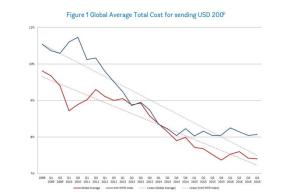
For more details, see the full writeup.
6 Reasons Companies Fail
Dead Companies Walking, by Scott Fearon
1) Historical myopia: learning from only the recent past.
This seems to be most prevalent in cyclical industries, such as energy. The author’s formative experience was starting at a Texas bank right before the oil bust of the 1980s. People looked at charts going back only a couple decades, and assumed that prices would drop only to a certain level. Equally absurd assumptions can be applied to all sorts of metrics that people use in the investment decision making process.
2) Relying too heavily on a formula.
If a company follows a strict formula or metric, such as adding a certain number of stores annually, they can quickly find themselves making illogical decisions. Value Merchants, a retailer is an example used in this chapter.
Investors that rely too much on formulas can end up investing in zombie companies on the cusp of obsolescence. Various yellow page companies, for example, looked extremely cheap on an EBITDA basis in the early 2000s.
Relying too much on formulas an result in errors of omission. For example, investors may that relied on a strict valuation formula would have turned down Starbucks and Costco in their early days.
Conventional Doesn’t Mean Conservative
) Philip Fisher pointed this out: Michael Mauboussin discusses tensions between the “business of investing”(ie getting enough AUM to stay in business) and the “profession of investing”(doing whats truly best for your clients over the long term). History shows
 that often blindly following crowds can be hazardous to your wealth. If you want to preserve and grow wealth, you have to know when the crowd is being stupid.
Discounted Venture Capital
I posted on Seeking Alpha about my investment in Crossroads Capital (XRDC), a busted venture capital BDC trading at ~60% of book value, with 70% of market cap in cash. It has a messy portfolio, but not a lot needs to go right for signficant upside. For those with the means and/or the investment mandate, getting an NDA and buying the individual portfolio companies from XRDC might be the better option. Crossroads Capital hired Setter Capital to market its holdings. Setter Capital specializes in the fascinating private equity secondary market.
Here are a few residual thoughts on deep value investing in the busted BDC/private equity/venture capital space.
There is a bit of irony in a deep value liquidation play with assets that consist of preferred shares in growth oriented venture capital investments. Venture capitalists bet big on change, while value investors generally focus on mean reversion, yet as Marc Andreessen pointed out, there are actually similarities between the philosophies underpinning value investing and venture capital. Both styles of investing emphasize fundamental analysis, long term thinking, and ignoring market noise, while taking advantage of some sort of mispricing.


However, a lot of venture capital investments are preferred equity with quite favorable liquidation preferences. The prospective buyer will conduct due diligence on the operations of the business, and the rights of the particular security. With an investment in XRDC one can determine the aggregate valuation paid by an outside investor(about 3x EBITDA after subtracting out all the excess cash in the BDC), and can compare valuations with other BDCs holding the same security (top holding is marked over 20% higher by another BDC), but there is limited public information on each individual security. Based on research of public sources, several of the portfolio companies appear to be doing pretty well, but a couple are also in trouble. My working hypothesis is that the absurdly large discount creates a “heads I win, tails I don’t lose that much” scenario. However, cherry picking the best companies out of XRDC’s portfolio and buying them directly would be even better.
I look forward to more opportunities like this.
The Hard Thing About Finding Easy Things
In the The Art of War
How can one develop a behavioral edge? Cultivating the right habits in order to be physically and mentally healthy goes a long way. Considering carefully what media to read is important to avoid being overwhelmed by noise. Finding time to think requires excellent resource management. It requires discipline to be willing to work on a name for months, only to pass on it, or to wait for months or even years for the right business to become cheap enough. Some might not enjoy spending hours reading about obscure nanocaps or corporate transactions, while ignoring popular stocks in the news. Some people seem naturally more willing to be contrarian, but I doubt anyone finds it easy all the time, especially during drawdowns. Being fearful when others are greedy, and greedy when others are fearful is harder than it sounds. Checking oneself for cognitive biases before any major financial decision is important. This is not an easy process, since cognitive biases have biological roots. I like to take a “red cell” approach, and try to understand potential short arguments for any stock I own. The connection between action and consequence is usually delayed in markets. It requires a lot of discipline, double checking and introspection to make your way through the vicissitudes of investing.
The cultivation of a structural edge is also nuanced. If you have developed a behavioral edge, then you can probably manage your personal finances in a way that allows your personal accounts to be invested for the long term. This requires maintaining excess liquidity at most times. If you manage money for other people, you have to be really careful who you take on as a client. If a client has a shorter time horizon than you, or are likely to need to pull money suddenly, the impact can be devastating. This is a difficult tradeoff, especially for small funds, since more AUM means more fees right away. With the right clients a capital markets disruption is a major opportunity, with the wrong clients it is a disaster. Whether in a personal account or a fund, simply having a long time horizon and a liquidity cushion can be a major source of long term alpha.
If one chooses to look at what other’s don’t one may actually end up with an analytical and informational edge in areas with less competition. I like to invest in things that are uninvestable for most investors with better resources, whether due to “headline” risk, illiquidity, or other institutional constraints. For example liquidations, delistings, and anything nanocap are fertile grounds for bargains. There are also interesting opportunities in distressed debt, and bankruptcies. I also like to look for situations where statistical services(Bloomberg, YCharts, Yahoo Finance, etc) are likely to have misleading or incomplete data, and companies that don’t fit in a comfortable category. Sometimes consolidated financials can be deceptive because of accounting rules, especially if a company has made acquisitions, holds real estate and/or holds a portfolio of securities. I also always make sure to adjust for material events that occurred after the 10-Q or 10-K date in determining a valuation. Judging by occasional market behavior I don’t think everyone does this. In any case there is always a gap between accounting reality and economic reality. The financial statements are just a starting point.
An ideal long term holding is a business that has a major competitive advantage and can easily earn a high return on capital over the long term, even if management screws up. These businesses are hard to find, and they’re sometimes hidden in a group of weak businesses that screened poorly, or attached to an old business that didn’t work. Thrift conversions are ignored by many, and easy to understand. Although the upside for thrift conversions is rarely large, the risk/reward tradeoff is phenomenal. Key information is often found on the OCC and FDIC websites, rather than in Edgar. Most OTC securities are ignored by sophisticated and large investors(plus the messiness of sorting through hundreds means you aren’t competing as much against computers). Sometimes I can get an informational edge by actually bothering to go to the company’s website and/or buying a token share and calling the company to ask for financials, which one has a legal right to access as a shareholder.
Whatever the investment, I’m only interested in buying if a lot can go wrong before I lose, and just a little going right provides a nice gain. Finding the right security is hard, but it should be easy to win once its in the portfolio. “Sifting through the debris of financial wreckage, out-of-favor securities and asset classes in which there is limited competition”, as Seth Klarman has called it does requires intense discipline and dedication, but provides ample rewards.
The extraordinary delusions and madness of crowds also serves up huge bargains from time to time, but the analysis is much harder. In all transactions, one must ask, why is someone willing to take the other side? I suspect there is more benefit to carefully analyzing my own psychology than to trying to outsmart others. I’d rather buy from a “non-economic” seller, when possible. Funds with industry or market cap mandates sell spinoffs indiscriminately. Funds that manage to an index dump companies kicked out indiscriminately. Delistings and liquidations are also sometimes forbidden by investment mandates regardless of the actual condition of the business or quality of the assets. I like to look at the portfolios of large concentrated funds that are facing massive redemption or shutting down, or from investors otherwise desperate for liquidity(oops did I say that out loud?). Sometimes people sell securities for reasons that make sense from the perspective of their job security, but are actually unrelated to the merits of the security being sold. Of course it takes a lot of searching to find where the right sellers are.
Charlie Munger told Howard Marks: “its not supposed to be easy, anyone who thinks its easy is stupid.” Indeed, finding easy things is hard.
 Ockham's Notebook