FOMO is a hell of a drug

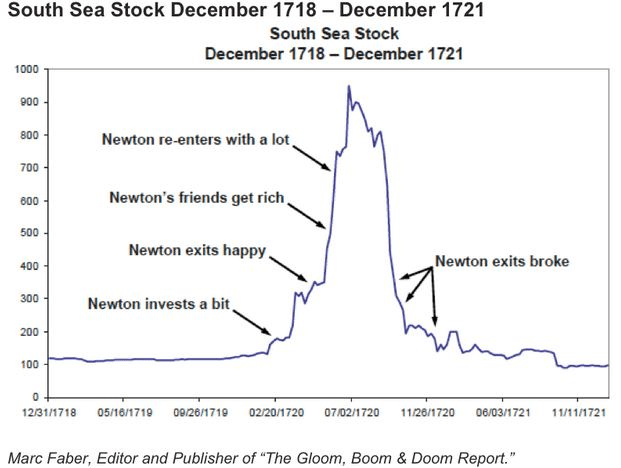
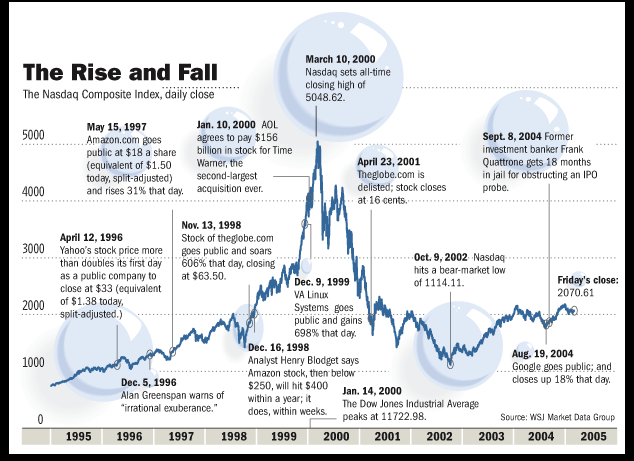
The most dangerous feeling in finance  is “fear of missing out”(FOMO). FOMO causes people to make hasty emotional decisions, generally near to the top of a speculative mania.  FOMO is the force behind ponzi schemes, stock promotions, and simple legit bubbles.  The Stanford Business School has even looked into this 

Fear of Missing Out

The danger of FOMO impacts people regardless of  socieoeconomic status or education. It even impacted Isaac Newton:

FOMO is a hell of a drug

Source: the Vantage, (which has some excellent personal finance tips on avoiding the dangers of FOMO)

Last week things got a bit volatile. Markets corrected all the way to… (wait for it) the price level of a couple months ago. This was the result of a sudden sharp reversal of record retail inflows. Although it wasn’t really an abnormal reversal, the media made it sounded like the beginning of another financial crisis.

Continue reading

Warren Buffett, Aesop's Fables, Dot-Com Bubble

Warren Buffett, Aesop’s Fables, and the Dot-Com Bubble

I recently went back and re-read the Berkshire Hathaway letters from during the dot-com bubble. Buffett and Charlie Munger mostly sat out the mania, then used Aesop’s Fables to explain it all when it was done. Investors can learn  from their ability to maintain equanimity amidst the madness of crowds.  However its also important to note that they made errors of omission as technology altered industries.  Investors do themselves a disservice if they automatically reject tech investments, just because those are not areas that Berkshire Hathaway invested.   Buffett’s letters to investors are a pretty good vantage point from which to understand repeating historical patterns.


1997: Maintain discipline in the mania

As the dotcom bubble started gathering momentum, Warren Buffett reaffirmed commitment to discipline:

Though we are delighted with what we own, we are not pleased with our prospects for committing incoming funds. Prices are high for both businesses and stocks. That does not mean that the prices of either will fall — we have absolutely no view on that matter — but it does mean that we get relatively little in prospective earnings when we commit fresh money.

Under these circumstances, we try to exert a Ted Williams kind of discipline. In his book The Science of Hitting, Ted explains that he carved the strike zone into 77 cells, each the size of a baseball. Swinging only at balls in his “best” cell, he knew, would allow him to bat .400; reaching for balls in his “worst” spot, the low outside corner of the strike zone, would reduce him to .230. In other words, waiting for the fat pitch would mean a trip to the Hall of Fame; swinging indiscriminately would mean a ticket to the minors.

If they are in the strike zone at all, the business “pitches” we now see are just catching the lower outside corner. If we swing, we will be locked into low returns. But if we let all of today’s balls go by, there can be no assurance that the next ones we see will be more to our liking. Perhaps the attractive prices of the past were the aberrations, not the full prices of today. Unlike Ted, we can’t be called out if we resist three pitches that are barely in the strike zone; nevertheless, just standing there, day after day, with my bat on my shoulder is not my idea of fun.

Although way too early, he started lamenting high prices:

In the summer of 1979, when equities looked cheap to me, I wrote a Forbes article entitled “You pay a very high price in the stock market for a cheery consensus.” At that time skepticism and disappointment prevailed, and my point was that investors should be glad of the fact, since pessimism drives down prices to truly attractive levels. Now, however, we have a very cheery consensus. That does not necessarily mean this is the wrong time to buy stocks: Corporate America is now earning far more money than it was just a few years ago, and in the presence of lower interest rates, every dollar of earnings becomes more valuable. Today’s price levels, though, have materially eroded the “margin of safety” that Ben Graham identified as the cornerstone of intelligent investing.

Notable Actions in 1997:

Net sales of 5% of the stock portfolio

increasing emphasis on “unconventional commitments”, including oil derivatives, and direct investments in silver.

1998: Trimming positions too early

Continue reading

Is credit really the smart money?

Conventional wisdom holds that credit markets are “smart institutional money” that sees problems faster than  equity markets that  are full of less sophisticated retail investors.  I question whether that is still empirically true.  Retail investors now own large portions of the credit market, including high yield. Credit markets appear to be distorted by a combination of indexation and a reach for yield.   Its possible that bonds trading at par can be a false comfort signal for an equity investor looking at a highly leveraged company, because in many recent cases equity markets have been faster to react to bad news.

Retail ownership of credit markets.

However you slice and dice the data, there is clearly a lot more retail money in credit than there was a decade ago.  The media  mostly reports on noisy weekly or monthly flows, even though there has been a clear long term change.

Bond funds in general have experienced dramatic inflows over the past decade:

bond mutual funds.png

Source: ICI Fact Book 2017


The issues becomes more serious when you look just at the high yield part of the market. Boaz Weinstein of Saba Capital estimated that between ½ or ⅓ of junk bonds are owned by retail investors in the current market. The WSJ cited Lipper data that says mutual fund ownership of high yield bonds/loans is $97 billion today vs $18 billion a decade ago. ICI slices the data differently, and comes up with a much nosier data set for just floating rate unds, indicating large outflows in 2014 and 2015.  However it shows net assets in high yield bond funds up 3x compared to 2007, and the total number of funds up over 2x during that time.

High Yield inflows.png

Source: ICI Fact Book 2017

Its not just mutual funds either- there are now more closed end type fund structures that market towards retail investors.  BDCs experienced a fundraising renaissance through 2014, and are now active in all parts of the high yield credit markets- from large syndicated loans to lower middle market.  Closely related, before the last financial crisis, ago there was minimal retail ownership of CLO equity tranches, but now there are a few specialist funds, and a lot of BDCs have big chunks of it as well.     Oxford Lane and Eagle Point were sort of pioneers in marketing CLO investments to retail investors but many others have followed.   Interval funds are a tiny niche, but over half the funds in registration are focused on credit.  It seems just about every asset manager is cooking up a direct lending strategy.  The illiquid parts of the credit market are harder to quantify, but there has been a clear uptick in retail investor exposure since before the financial crisis.  The marginal buyer impacting pricing is increasingly likely to be a retail investor rather than an institution.  

Retail investors to exhibit more extreme herding behavior.  According to Ellington Management Group:

This feedback loop between asset returns and asset flows has magnified the growth of the high yield bubble.

Capital Distortions

Its pretty easy to make a loan, its much harder to get paid back.

-Jeffrey Aronson, Centerbridge Capital

Continue reading

Trump’s foreign policy: Pulling a Homer

It is almost universally accepted that Donald Trump’s foreign policy is going to be a disaster. But what if his bizarre antics actually work? What if Trump pulls a Homer on foreign policy?

Trump Foreign Policy: Pulling a HomerTrump Foreign Policy: Pulling a Homer

Pulling a Homer

Here’s a scenario under which Trump ends up being known as a foreign policy success. It probably won’t happen, but if it does, you heard it here first.

  • The Iran protestors succeed in replacing or drastically reforming the government in Iran. The new regime remembers Trump was the first world leader to directly support them. US-Iran relations open up. Trump takes credit whether he deserves it or not.
  •  China and South Korea get so concerned with Trump’s impulsiveness that they finally decide to take action on North Korea. Trump takes credit whether he deserves it or not.
  • Israel and Palestine come  together in sort of a reverse Camp David summit as a result of Trump’s recognition of Jerusalem as the capital of Israel. Both parties are concerned with Trump’s bizarre behaviour, and finally start negotiating from realistic basis. Trump takes credit whether he deserves it or not.
  • As a result ⅔ of the “Axis of Evil”  is fixed through diplomatic means, and Middle East peace achieved during the Trump administration. History books go on to credit him as a highly persuasive foreign policy president. Scott Adams’ “4d Chess” analogy for Trump’s actions, however preposterous it seems now, ends up becoming the accepted narrative.

Trump Foreign Policy Compared to Nixon

Continue reading

Minsky and the Junk Bond Era

King of Capital: The Remarkable Rise, Fall, and Rise Again of Steve Schwarzman and Blackstone discusses the early days of the leveraged buyouts(LBOs) and junk bonds from the vantage point of Blackstone’s founders.

In 1978, KKR did an LBO of an industrial pumps make (Houdaille Industries). There had been many small LBOS of private businesses, but no one had gone that big,  done a public company. A young investment banker named Steve Schwartzman heard about the deal and realized he had to get his hands on that prospectus. “He sensed something new was afoot — a way to make fantastic profits and a new outlet for his talents, a new calling.

“I read that prospectus, looked at the capital structure, and realized the returns that could be achieved.” he recalled years later. “I said to myself, ‘This is a gold mine.’ It was like a Rosetta stone for how to do leveraged buyouts. “

Speculative Bridge Financing

It quickly became apparent how lucrative leveraged buyouts could be.

LBOs were financed with Junk Bonds. The process of issuing junk bonds was messy and cumbersome. It took most banks an extremely long time to issue bonds. Drexel was so adept at hawking junks, that companies and other banks in a deal would go forward on an LBO based solely on Drexel’s assurance that it was “highly confident” it could issue bonds. Other banks that couldn’t do that would offer short term financing, aka bridge loans, so a buyer could close a deal quickly, and then issue bonds later to repay bridge loans This alowed DLK, Merril Lynch, and First Boston to compete with Drexel in the LBO financing space.

But what if the bonds couldn’t issued? How would the bridge loan be paid for?

… bridge lending was risky for banks because they could end up stuck with inventories of large and wobbly loans if the market changed direction or the company stumbled between the time the deal was signed up and the marketing of the bonds. The peril was magnified because bridge loans bre high, junk bond-like interest rates, which ratcheted up to punishing levels if borrowers failed to retire the loans on schedule. The ratchets were meant to prod bridge borrowers to refinance quickly with junk, and up until the fall of 1989, every bridge loan issued by a major investment bank had been paid. But the ratchets began to work against the banks when the credit markets turned that fall. The rates shot so high that the borrowers couldn’t afford them, an the banks found themselves stuck with loans that were headed towards default.

In the late 80s/early 90s. several junk bond deals fell through with disastrous consequences. The $6.8 billion United airlines buyout turned out poorly. Several stores ended up going bankrupt due to a failed junk bond deal: Federated Department stores , the parent of Bloomingdale’s, Abraham & Strauss, Filene’s and Lazarus, etc. etc. First Boston nearly failed due to its exposure to junk bond deals. Blackstone mostly sidestepped the worst problems of the era, but fought hard to get refinancing in some cases, and had a couple deals jeopardized.

The Minsky view of junk bonds and LBOs

The collapse of the bridge financing market in the junk bond era illustrates a key idea in Hyman Minsky’s Financial Instability Hypothesis: the idea of three types of leverage.

Continue reading

Optimizing An Organized Mind

How can one maximize mental performance? The Organized Mind- Thinking Straight in an Age of Information Overload by Daniel Levitin is a book that works towards an answer to this question. The book’s ideas on offloading things to external systems and organizational techniques are very similar to David Allen’s , Getting Things Done . However, The Organized Mind, provides much more historical and scientific background an context. Further, An Organized Mind avoids being overly prescriptive, and instead gives the reader ideas on how to best optimize for their own situation.

Some of my highlights on the key themes of the book:

Getting the mind into the right mode

One useful framework that the books develops is hte idea of the mind as functioning in different modes. An important component of high performance is the ability to use the right mode at the right time.

There are four components in the human attention system: the mind-wandering mode, the central executive mode, the attention filter, and the attention switch, which directs neural and metabolic resources among the mind-wandering, stay-on-task, or vigilance modes.

Remember that the mind-wandering mode and the central executive work in opposition and are mutually exclusive states; they’re like the little devil and angel standing on opposite shoulders, each trying to tempt you. While you’re working on one project, the mind-wandering devil starts thinking of all the other things going on in your life and tries to distract you. Such is the power of this task-negative network that those thoughts will churn around in your brain until you deal with them somehow. Writing them down gets them out of your head, clearing your brain of the clutter that is interfering with being able to focus on what you want to focus on. As Allen notes, “Your mind will remind you of all kinds of things when you can do.

The task-negative or mind-wandering mode is responsible for generating much useful information, but so much of it comes at the wrong time.

Creativity involves the skillful integration of this time-stopping daydreaming mode and the time-monitoring central executive mode.

Insights into how human memory works

The book delineates the nuances of human memory by comparing it to systems in the physical world.

Being able to access any memory regardless of where it is stored is what computer scientists call random access. DVDs and hard drives work this way; videotapes do not. You can jump to any spot in a movie on a DVD or hard drive by “pointing” at it. But to get to a particular point in a videotape, you need to go through every previous point first (sequential access). Our ability to randomly access our memory from multiple cues is especially powerful. Computer scientists call it relational memory. You may have heard of relational databases— that’s effectively what human memory is.

Having relational memory means that if I want to get you to think of a fire truck, I can induce the memory in many different ways. I might make the sound of a siren, or give you a verbal description (“ a large red truck with ladders on the side that typically responds to a certain kind of emergency”).

This feature can lead to either valuable insights or being overwhelmed, depending on how it is controlled:

If you are trying to retrieve a particular memory, the flood of activations can cause competition among different nodes, leaving you with a traffic jam of neural nodes trying to get through to consciousness, and you end up with nothing.

Categorization is key to mental functioning.

This ability to recognize diversity and organize it into categories is a biological reality that is absolutely essential to the organized human mind.”

Shift burdens to external systems

You might say categorizing and externalizing our memory enables us to balance the yin of our wandering thoughts with the yang of our focused execution.

Continue reading

The next level of shareholder activism

…shareholder activism can be put to good use and bad. It challenges inefficient corporations that waste valuable assets, but it can also foster destructive and destabilizing short-term strategic decisions. The key issue in an activist campaign often boils down to who will do a better job running the company—a professional management team and board with little accountability, or a financial investor looking out for his or her own interests.

Dear Chairman: Boardroom Battles and the Rise of Shareholder Activism

Elliott Management is a prominent hedge hedge fund with a succesful 4 decade track record, perhaps most infamous for seizing a  ship from Argentina’s Navy during a debt dispute back in 2012. Elliott has become a most widely known as an activist investor in recent years.  Its impact has also been important because it has shaken up large companies previously thought immune to activists. Furthermore, Elliott has been a successful activist in Europe and Asia, where conventional wisdom once held  that activism didn’t really work.

Elliott’s tactics are extreme, and controversial, but they work. Although sometimes there are unintended consequences- Elliott has indirectly affected regime change in two different sovereign nations.  Fortune’s latest issue has an in depth profile of Elliott Management that is well worth reading.

For more on the history of corporate activism, and its impact on  the history of capitalism,  Dear Chairman is a definitive guide.

Business history teaches us that the pursuit of profit brings out an extreme and obsessive side of people. When we harness it well, we get Wal-Mart, Les Schwab Tires, Southwest Airlines, and Apple. When we don’t, we get salad oil swindles, junk bond manipulations, and Steak ’n Shake funneling its cash to its CEO’s hedge fund. The publicly owned corporation has been a remarkable engine engine for progress and economic gowth because it can place large amounts of capital in the hands of the right people with the right ideas. Without proper oversight, however, public companies can squander unimaginable amounts o money and inflict great harm on everything around them. The emergence of the shareholder as the dominant force in corporate governance has bestowed a tremendous amount of power and responsibility on investors….

Dear Chairman

Is it really necessary to have a meeting?

A lot of time and money is wasted on unnecessary corporate meetings. Since the early days of Amazon , Jeff Bezos has taken a unique approach to meetings.


At a management offsite in the late 1990s, a team of well-intentioned junior executives stood up before top brass and gave a presentation on a problem indigenous to all large organizations: the difficulty of coordinating far-flung divisions. The junior executives recommended a variety of different techniques to foster cross group dialogue and afterward seemed proud of their own ingenuity. Then Jeff Bezos, his face red, and the blood vessel in his forehead pulsating, spoke up.

“I understand what you are saying, but you are completely wrong,” he said.

“Communication is a sign of dysfunction. It means people aren’t working together in a close, organic way. We should be trying to figure out a way for teams to communicate less with each other, not more.”

…At that meeting and in public speeches afterward, vowed to run Amazon with an emphasis on decentralization and independent decision-making. “A hierarchy isn’t responsive enough to change,” he said. “I’m still trying to get people to do occasionally what I ask. And if I was successful, maybe we wouldn’t have the right kind of company.

Bezos’s counter intuitive point was that coordination among employees wasted time, and that the people closest to problems were usually in the best position to solve them. That would come to represent something akin to the conventional wisdom in the high-tech industry over the next decade. The companies that embraced this philosophy, like Google, Amazon, and, later, Facebook, were in part drawing lessons from theories about lean and agile software development. In the seminal high-tech book The Mythical Man-Month, IBM veteran and computer science professor Frederick Brooks argued that adding manpower to complex software projects actually delayed progress. One reason was that the time and money spent on communication increased in proportion to the number of people on a project.

When you do have a meeting, make it useful

Of course, some meetings are necessary. There is value to cross-pollination of thoughts among intelligent people. Some processes do require explicit coordination and discussion. However, in practice, many hours are wasted on routine updates, grandstanding, and “thinking out loud”. To ensure meetings were productive Bezos required the person who leads a meeting to write detailed prose explaining their thoughts. The first half hour or so of every meeting would be silent reading time. This ensured everyone thought deeply and expressed complete thoughts cogently.

Meetings no longer started with someone standing up and commanding the floor as they had previously at Amazon and everywhere else throughout the corporate land. Instead, the narratives were passed out and everyone sat quietly reading the document for fifteen minutes—or longer. At the beginning, there was no page limit, an omission that Diego Piacentini recalled as “painful” and that led to several weeks of employees churning out papers as long as sixty pages. Quickly there was a supplemental decree: a six-page limit on narratives, with additional room for footnotes.

Riches Among the Ruins

No Economy is too small, no political crisis is too dire, and no country is too bankrupt for a solo operator like me to find riches among the ruins.

-Robert Smith

Riches Among the Ruins: Adventures in the Dark Corners of the Global Economy is an incredibly entertaining bottom up look at frontier market crises over the last 3 decades from the perspective of a travelling distressed debt trader.  Each chapter is dedicated to Robert Smith’s experience in a particular country: El Salvador, Turkey, Russia, Nigeria, Iraq, etc, etc. Each country is unique, but Smith’s weaves several key lessons throughout his memoir.

Anyone who seeks  profits in inefficient markets could benefit from Smith’s experience.

Information vacuums are key for middleman and arbitrageurs

In the mid 1980s no one had any idea what an El Salvador bond was worth- which is to say, they had no idea what value others might attach to it. The ignorance, this information vacuum, was my bliss. The seller’s price was simply a measure of how desperately he wanted to dispose of a paper promise of the government of El Salvador, and the buyer’s measure of how eager he was to convert his local currency into a glimmer of hope and seeing dollars down the road. The spread, my profit, was the difference between the two. In a fledgling market, with no reporting mechanisms and precious little information floating around, the spread can be enormous, and there was no regulatory or legal restrictions on how much you could make on a transaction.

Though my sellers and buyers, usually the representative of foreign companies doing business in El Salvador, often knew each other , played golf together, or broke bread together at American Chamber of Commerce breakfasts, I knew it would take some time before they eventually started to compare notes. At the beginning I doubt any of them even mentioned they were trying to sell or buy El Salvador bonds because the market didn’t exist yet. But until the market matured it was a gold rush, and I developed a monopoly on that most precious of all commodities in any market: information. I found out who wanted to sell, who wanted to buy and their price, and I held that information very tight to the vest.

In some cases buyers and sellers were on different floors in the same office building, or different divisions of the same global corporation.  The biggest challenges for foreign companies doing business in the developing world was converting local currency revenues back into dollars.  One way to get money out was to buy dollar bonds at fixed exchange rate and over time collect principal and interest in dollars.

Creativity and information edge: Struggles over bondholder lists

In almost every country, Smith, goes through difficulty to get the list of people holding the bonds in which he was seeking to make a market. Arbitrageurs and brokers who had access to the list guarded it aggressively, because it gave them an edge in acquiring positions at a discount, or profiting as a middleman. This was a key bit of information, available from connections at the Central Bank or other places.

Continue reading

9 Steps to 10x Thinking

Smartcuts: How Hackers, Innovators, and Icons Accelerate Success is a book about the power of lateral thinking- solving problems through an indirect or creative approach. “Smartcuts” means sustainable success achieved through smart work.  This is different than “shortcuts”, which are rapid, but short term gains. Ultimately the book outlines 9 key ideas, that lead up to the concept of “10x thinking”.

#1 Hacking the Ladder

Find sideways paths, like the warp pipes in Super Mario  that allows someone to beat the game in seconds, not hours.

#2 Train with Masters

Find mentors, and/or study the greats. Shoe designer Dwayne Edwards stole discarded shoes so he could study and draw the designs. This helped him develop the ability to notice tiny design details in shoes.

#3 Rapid Feedback

Rapid feedback accelerates learning. This has been critical to a lot of companies that have a website as their main product. In this book, the example of Upworthy illustrates the point. Turn work into rapid scientific experiments, and depersonalized feedback.

#4 Platforms

Tools and technology that people can buid off of. a platform “amplifies the effort and teaches skills in the process of using it.“ Key example: development of Ruby on Rails as a programming language.

Platforms are how Twitter could build Twitter in mere days while running a separate company. And Platforms are why Finland made all its teachers get a Master’s degrees and its students learn with hands-on tools that made learning better.

See also: Modern Monopolies: What It Takes to Dominate the 21st Century Economy

#5 Catching waves

The world’s best surfers arrive at the beach hours before a competition and stare at the ocean. This is a valuable metaphor for a lot of things in business and life.

“Intuition is the result of nonconscious pattern recognition,” ….. However, research shows, that we can also see patterns just as well by deliberately looking for them. Deliberate pattern spotting can compensate for experience. “but often people don’t even try it”

Budgeted Experimentation helps business avoid being disrupted, by helping them harness waves on which younger competitors might otherwise used to ride past them. Its helped companies like Google, 3M, Flickr, Conde Nast, and NPR remain innovative even as peer companies plateaued. In contrast, companies that are too focused on defending their current business practice and to fearful to experiment often get overtaken.

Key example of what to avoid: Kodak

#6 Superconnecting

Key example: Che Guevera taking control of the radio, using it as a way of promoting Castro’s revolution to a much wider audience than otherwise possible.

#7 Momentum

Build up potential energy, and amplify unexpected opportunities.

#8 Simplicity

The key feature of disruptively innovative products is cost savings(either time or money). But the key ingredient behind the scenes of every disruptive product is simplification.

Examples, email, USB Drives, Cars.(Henry Ford kept complexity under the hood).

Key example: Sherlock Holmes. He focused on what he needed to know, knowing how to figure out what he didn’t know, and forgetting about everything else.

#9 10x thinking

This quote from Astro Teller is key:

Its often easier to make something 10 times better than it is to make it 10 percent better…. In order to get really big improvements you usually have to start over in one or more ways. You have to break some of the basic assumptions and, of course, you can’t know ahead of time. Its by definition counter intuitive.

This means getting to first principles. 10x thinking forces you to come up with smartcuts.

10x thinking is probably now essential for survival in the modern economy.

Most innovation inside industries and companies today focuses on making faster horses, not automobiles.

This is why the innovator’s dilemma destroy’s so many companies.  What replaces them is something better.  Creative destruction is a beautiful thing.